
Why Composable Architectures are a Game-Changer for Retail
The retail landscape is evolving at an unprecedented pace. Customer expectations are higher than ever, demanding personalized experiences, seamless omnichannel journeys, and rapid innovation. Traditional monolithic e-commerce platforms, once the standard, are increasingly struggling to keep up. This is where composable architectures step in, offering a revolutionary approach that empowers retailers to build agile, flexible, and future-proof digital commerce solutions.
What is Composable Commerce?
At its core, composable commerce is an architectural paradigm that involves selecting best-of-breed, independent commerce components (often called Packaged Business Capabilities or PBCs) and "composing" them into a custom solution tailored to specific business needs. Instead of a one-size-fits-all platform, retailers can pick and choose functionalities like product information management (PIM), cart & checkout, search, order management, payments, and content management from different vendors and integrate them via APIs.
The Limitations of Monolithic Platforms in Modern Retail
Monolithic platforms bundle all functionalities into a single, tightly coupled system. While this can offer simplicity initially, it often leads to several challenges for growing retail businesses:
- Slow Innovation Cycles: Updating or adding new features can be complex and time-consuming, as changes in one part of the system can have unintended consequences elsewhere.
- Vendor Lock-in: Retailers are often tied to the roadmap and capabilities of a single vendor, limiting their ability to adopt new technologies or services quickly.
- Scalability Issues: Scaling specific functionalities independently can be difficult. You often have to scale the entire platform, which can be inefficient and costly.
- Difficulty in Personalization: Implementing highly personalized customer experiences across different touchpoints can be cumbersome with rigid, all-in-one systems.
Key Advantages of Composable Architectures for Retailers
Adopting a composable approach offers significant benefits that directly address the challenges faced by modern retailers:
- Unmatched Agility and Speed-to-Market: Retailers can quickly add, remove, or swap components as business needs change or new technologies emerge. This allows for faster deployment of new features and experiences.
- Best-of-Breed Functionality: By selecting specialized solutions for each commerce capability, businesses can leverage the best tools available for specific tasks, rather than settling for the "good enough" features of a monolithic suite.
- Enhanced Customer Experiences: Composable architectures make it easier to integrate various data sources and tools, enabling highly personalized and consistent customer journeys across all channels (web, mobile, in-store, social).
- Future-Proofing and Scalability: The modular nature allows businesses to scale individual components based on demand and easily adopt new technologies without overhauling the entire system. This reduces risk and protects investments.
- Reduced Vendor Lock-in and Lower Total Cost of Ownership (TCO): Retailers have the freedom to choose vendors for each component, fostering competition and potentially lowering costs. They can also optimize spending by only paying for the functionalities they truly need.
Transitioning to a composable architecture is a strategic move that requires careful planning and a clear understanding of business objectives. However, the long-term benefits in terms of agility, innovation, and customer-centricity make it a compelling proposition for retailers aiming to thrive in the dynamic digital commerce landscape. At AGSA Consulting, we specialize in helping businesses navigate this transition, designing and implementing robust composable solutions that drive growth and competitive advantage.
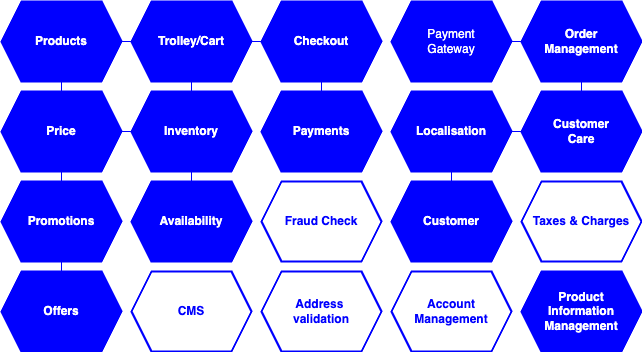
Key Components of a Composable Commerce Architecture:
- PIM (Product Information Management): Centralized management of product data.
- OMS (Order Management System): Streamlining order processing and fulfillment.
- CMS (Content Management System): Creating and managing engaging content.
- Search and Discovery: Enhancing product discoverability.
- Payment Gateways: Secure and seamless payment processing.
- CRM (Customer Relationship Management): Managing customer data and interactions.
- Headless Commerce: Decoupling the front-end presentation layer from the back-end commerce engine.
Who Benefits from Composable Commerce?
- Businesses with complex e-commerce needs.
- Organizations seeking to personalize customer experiences.
- Companies that require rapid innovation and agility.
- Businesses looking to integrate with multiple systems and channels.
- Large enterprises.
The Future of E-commerce:
Composable commerce represents a paradigm shift in how businesses approach e-commerce. By embracing this modular and flexible architecture, you can build a digital future that is adaptable, scalable, and customer-centric.
In conclusion:
Composable commerce is not just a trend; it's a strategic imperative for businesses looking to thrive in the digital age. By breaking down the monolithic e-commerce stack and embracing a best-of-breed approach, you can build a platform that is truly tailored to your unique needs and empowers you to deliver exceptional customer experiences.
Blog Categories

Recent Post